The Yorkshire Terrier is a wonderfully energetic toy dog who originated in Scotland and was later brought to England. These dogs are believed to have been developed from a combination of other Terrier breeds and are popular choices for anyone seeking small, loyal, loving canine companions. These dogs are often referred to affectionately as "Yorkies" rather than by their full breed name. If you're looking for a small dog with a feisty attitude and glamorous good looks, a Yorkie may be just the dog for you!
Origin and History
According to the American Kennel Club (AKC) history of the breed, the Yorkshire Terrier originated in the English town of Yorkshire. They're believed to be descendents of the Waterside Terrier, who shared some characteristics with Yorkies as we know them today. The Waterside was small in stature and had a long, blue-colored coat. Other breeds likely involved in the Yorkie's development include Manchester and Skye Terriers, and possibly a little Maltese thrown in, as well.
Despite their regal looks, Yorkies had some very humble beginnings. They were developed as working dogs, and their primary duty was to catch rodents in cloth mills in order to keep the population down and save the cloth from being chewed and destroyed. These early specimens were a bit larger than the toy dogs you see today. They were gradually bred down in size and became fashionable pets. It's at this stage the breed really began to thrive and gain notoriety.
Known for a time as a Scotch Terrier, the Yorkie's name officially became the Yorkshire Terrier around 1870. The breed was eventually recognized in 1885 by the AKC and has been allowed to compete in AK-licensed shows since 1878. They are also recognized by other kennel clubs across the globe, including:
- United Kennel Club
- The Kennel Club (Great Britain)
- New Zealand Kennel Club
Biewer Yorkies
In 1984, a piebald or "parti-color" Yorkie pup turned up in a litter bred by Gertrud and Werner Biewer of Germany. Due to the activation of a recessive gene, this puppy had white on their chest, legs, and belly, with typical Yorkie coloring elsewhere on the rest of the body. The breeders found this puppy quite attractive and decided to try to establish a line that would consistently produce the piebald type. They were successful and gave this line the name "Biewer Yorkies."
Today, many breeders consider the Biewer a breed in their own right as long as there are at least three generations of pure Biewer breeding behind a litter. Although some breeders still crossbreed Biewers and Yorkshire Terriers, this practice is largely frowned upon because the color requirements for Yorkies are so specific.
Aside from the difference in coloring, Biewers are basically the same as Yorkies under their coats.
Breed Characteristics
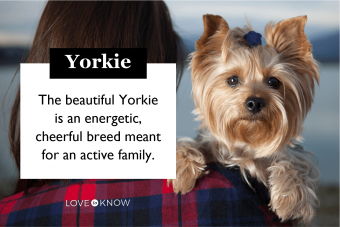
These dogs have what is called "small dog syndrome." They are known for acting larger than they are and are often fearless in the face of danger.
Appearance
The Yorkshire Terrier is a fine-boned little dog who weighs between 3 and 5 pounds, but should not exceed 7 pounds. They are rectangular when viewed from the side, and the head is only slightly domed with a medium length muzzle. The upper and lower teeth meet in a scissors bite, which means the lower front teeth fit just behind the upper front teeth when the jaw is closed. The ears should be pricked, and the dog should seem very alert.
Tails are typically docked short in the United States when the puppies are no more than 3 days old. However, docking is considered barbaric in many countries where the practice is now outlawed or at least strongly frowned upon.
The breed's coat is their crowning glory; it's very long and silky when kept in proper condition. The AKC standard governing color for this breed is very specific and requires a dark steel blue on the main body and clear gold on the face, chest, and legs.
Puppies begin life colored black and a rich tan, but this coloring gradually lightens with age. The blue begins to grow in along the spine and eventually replaces all the black hair in adult dogs who attain the correct coloring, although some dogs retain the black-and-tan coloring well into old age. For showing, the hair on a Yorkie's head may be tied up in a single or double top knot.
Yorkies carry themselves in a very upright manner, and their steps are quick and light. Their gait is very smooth, and dogs in full coat look as though they are gliding rather than walking. The topline should be level, and the tail should be held high when the dog is moving. The front legs should move parallel to each other when viewed from the front with nice reach forward when viewed from the side. The rear legs should also move parallel to each other when viewed from the rear, and the pads of the feet should be visible as the dog's feet kick out behind them when they move away from you.
Personality

While these dogs are quite tiny, they don't seem to be aware of that fact. Yorkies have true terrier temperaments and therefore have the heart of a lion. Yorkies are very adventurous. They will chase anything that resembles a rodent and are known to be prolific climbers to the point of scaling 4-foot-high chain-link fences. Although they look like elegant toy dogs, they are true terriers in every sense of the word.
To their human companions, Yorkshire Terriers are very affectionate and devoted, and they enjoy spending many hours snuggling or playing. However, their treatment of other dogs, whether of their own breed or another, can be a little aggressive. Yorkies are highly territorial, as many terriers can be. They will scrap to defend anything they perceive as one of their possessions. This inclination varies in strength for each individual animal, but it's a mainstay of the breed's temperament. This territorial nature leads to more barking than some other breeds.
While Yorkshire Terriers make wonderful pets for adults and older children, their physical delicacy does not make them ideal companions for young children who may accidentally injure their pets.
Training
Since Yorkshire Terriers are highly territorial, they have a strong instinct to mark their territory and tend to do so around the house. Once this behavior begins, it is extremely difficult to curb. Great diligence is required for house training, and males are a little more difficult to train than females. It is a good idea to provide a spot for newspaper or potty pads.
Yorkies are also very intelligent, and they can quickly learn to do anything they actually want to do. Obedience training and agility training are both terrific options for owners and dogs to pursue. The sight of a Yorkie flying over a jump is truly amazing to behold.
Exercise Requirements
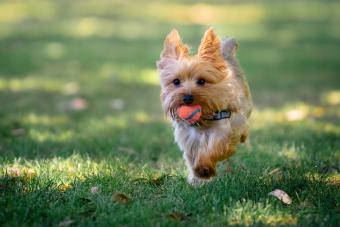
Yorkies aren't necessarily hyper dogs, but like any terrier, they do need enough exercise to burn off excess energy and avoid behavior problems. Toy dogs generally get a good deal of exercise just trotting around the house and playing, but it's also important for them to go on daily walks.
In addition to the exercise this brings, going on walks also provides much needed mental stimulation that can help stave off boredom. A simple, daily walk around a block or two will help keep your Yorkie in good physical and mental shape, and you'll likely find your pet is better-behaved in your home, as well.
Health Concerns
Yorkies are generally robust little dogs, but some do have health challenges like many other purebred dogs. According to Joseph Hahn, Information Specialist for the University of Illinois College of Veterinary Medicine, there are several main health issues in this breed to be aware of:
- Portosystemic Shunts: This is either a congenital or acquired condition in which blood flows around the liver instead of through it.
- Hypothyroidism: The thyroid gland stops producing thyroid hormones and no longer functions normally.
- Renal failure: This is a slow deterioration of the kidneys caused either by inherited or acquired disorders.
- Luxating patellas: Weak ligaments allow the kneecap to painfully slip out of place.
- Legg-Calvé-Perthes syndrome: Lack of sufficient blood flow in the hip joint causes painful degeneration and ultimate collapse of the femoral head.
- Hypoglycemia: Most common in young puppies and extremely small Yorkies, this condition causes low blood sugar, which in turn leads to a host of symptoms and other health problems.
- Tooth decay: Teeth are sometimes crowded in the Yorkie's tiny jaws, and this traps food particles that lead to plaque buildup, cavities and gum disease. Left unchecked, bacterial infection can cause heart disease.
- Skin allergies: Allergic reactions to a variety of environmental elements, parasite bites, and even some foods can cause rashes and intense itching.
- Collapsed tracheas: Especially prominent in very tiny Yorkies, this condition is caused by a progressive weakening of the tracheal walls. While this is usually considered a genetic condition, the trachea may also collapse due to excessive pressure from a dog's collar.
- Broken bones: Yorkies have very fine bones, so they are prone to accidental injuries.
- Eye infections, ulcerations, and cataracts: These typically stem from hair rubbing the eyes or abnormal eyelash growth, also known as distichiae.
Diligent breeders are working hard to identify dogs afflicted with serious health problems and refrain from using them in their breeding programs. Due to the tiny size of their lungs, Yorkies are also not terrific candidates for anesthesia and must be carefully monitored if surgery is required.
Lifespan
Despite the health problems common to this breed, Yorkies are fairly long-lived as long as they receive regular vet checks and proper vaccinations, good nutrition, moderate exercise and regular grooming. Most dogs live a minimum of 10 years, but many live an average of 12 to 15 years. A few well-cared for pets live even longer.
"Teacup" is a term applied to extremely small Yorkies that typically weigh around 2 pounds or less. This is not a recognized variety within the breed, and unscrupulous breeding practices are often associated with "teacup" litters. These tiny dogs are quite delicate and tend to have shorter lives than standard-sized Yorkies due to their propensity for health problems and injuries. Subsequently, they often only live between 5 and 8 years on average, though some survive for even short periods than that.
Grooming
Taking care of a Yorkie's coat is essential. They have fine, almost human-like hair, and their coat does not typically shed. Yorkie owners typically keep them in either "show" coats, where the full flowing coat reaches the floor, or "pet" coats, which are trimmed short for convenience.
A full show coat requires meticulous care and daily brushing. If you keep your Yorkie's coat short, you still need to brush your dog periodically to remove tangles and mats, especially as it grows out. Because a Yorkie's coat is delicate, it needs to be trimmed roughly every four to six weeks to ensure it remains in its best condition.
Famous Members of the Breed
Certain dogs stand out in this breed's history. Here are a few of the most famous.
- Huddersfield Ben: Ben was a top show dog and was also considered the top stud dog of his era. He is credited with instilling the main characteristics found in the breed today.
- Sylvia: An English Yorkie owned by Arthur Maples, Sylvia went down in history as the smallest dog that ever lived. She weighed just 4 ounces, stood only 2.5 inches tall and was just 3.5 inches long.
- Ch. Ozmilion Mystification: This Yorkie became the first of the breed to win Best in Show at the prestigious Crufts dog show in 1997.
- Ch. Cede Higgins: According to Westminster Kennel Club records, Higgins is the only Yorkie who has won Best in Show at Westminster so far. That occurred in 1978.
Purchasing or Adopting a Yorkie
If the Yorkie seems like the right dog for your lifestyle, visit several reputable breeders or rescue shelters so you can get to know the breed better. Visit the Yorkshire Terrier Club of America for information about choosing a puppy and for referrals to reputable breeders. You can expect to pay between $300 and $800, with some reaching up to $1,500.
Rescue Organizations
If you'd prefer to adopt a rescue dog rather than purchasing a puppy, you can begin by searching Save-a-Rescue and PetFinder. You can also search breed-specific rescue organizations:
- Yorkie Rescue of America: A non-profit, volunteer-based rescue organization that often takes dogs in need of extensive medical care and attention.
- Save a Yorkie Rescue: An organization dedicated to ensuring each Yorkie is placed in a suitable home.
- Yorkie911 Rescue: A New York-based rescue serving the tri-state area with Yorkies of all ages and backgrounds.
Is This the Breed for You?
The Yorkie can be quite energetic, so they aren't recommended for those who are primarily sedentary. Although they can live in apartments, if you can't provide them with sufficient exercise each day, you may want to look for a breed that is less active. On the other hand, if you are an active person who enjoys a daily walk and are prepared to provide adequate attention, you can begin your search for the right Yorkie for your lifestyle.